
The Elwes Family
Recipe & Remedy Book
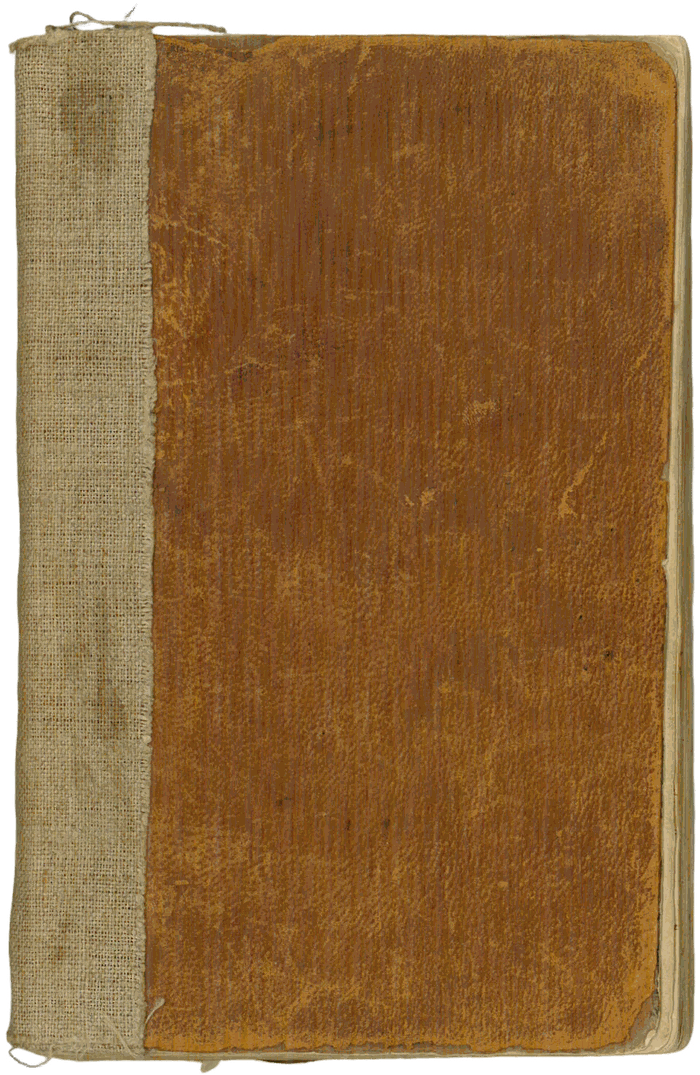
Medical & household receipts of the Elwes family
probably of Colesbourne Park, Gloucestershire, c. 1828 to 1840
Bought by the present owner about 20 years ago in Burford, looked at occasionally, and now at last brought to life...
You will find the complete transcription below, but first some notes...
About the manuscript
A household receipt book of 77 written pages (the last is blank), mixing medical remedies with recipes for cooking, preserving, brewing and household tasks such as stain removal, ink, paint and limewash.
The book was compiled over a long period and in several hands. The early pages are in a neat, regular hand; later entries vary in hand, ink and size, some are added in pencil, and two receipts (pages 71 and 75) are written on slips of paper pasted in.
Dating
The last section supplies the only dates in the book: “1828” (pages 54 and 55, including a cough “which Sus. & Emily had very bad in the Spring of 1828”), “March 1829” (page 59), “Feb 1830” (page 62), “Novr 38” (page 72) and “1840” (page 73). Most entries therefore seem to have been made in the late 1820s and 1830s, with additions to about 1840.
The earlier pages are consistent with this. Sir Richard Croft M.D. (page 19), the royal accoucheur, died in 1818, so his note on infant teeth may have been copied from an older source. The practitioner called “Mr Clarke” on page 35 (and probably “Mr Clark” on page 49) seems to be the same man as “Sir C M Clarke” on pages 74 and 75. If he is Charles Mansfield Clarke, the London accoucheur who was made a baronet in 1831, the change of title fits the order of the entries, but this identification is a suggestion only.
The household
The last section shows that the book belonged to, or was kept for, an Elwes family (see the next section for a probable identification). Entries mention “Mr Elwes” (page 55), “Mrs Elwes” (page 49) and “Mrs E.” (page 59). Page 58 is signed “Emily Elwes”, and “Mrs T H Elwes” and “Mrs T H C Elwes” appear on page 75. Children are named in several remedies: Sus. and Emily (pages 54 and 62), Margaret, “nearly 3 yrs old” (page 53), and Charlotte (page 61). Several entries are written for a “child 5 yrs old”.
A note on page 48 records a man cook at 51 Curzon Street, Mayfair, “recommended by Mrs Dixon”, which suggests the family had London connections.
Probable identification: the Elwes family of Colesbourne
The book was bought in Burford, and the names in the book fit closely with the family of Henry Elwes of Colesbourne Park, near Cheltenham, Gloucestershire. Henry Elwes married Susan Hamond (1784 to 1832), daughter of Anthony Hamond of Westacre, Norfolk, at Westacre on 8 June 1813. Susan brought the Congham estate, near King’s Lynn, to the marriage, and the family divided its time between Congham House and Colesbourne. Their nine children were Susan, Emily, John Henry (1815 to 1891, later of Colesbourne), Catherine, Maria, Robert (1819 to 1878, of Congham, the painter), Charlotte Ann, Margaret and Frances.
• The children: “Sus. & Emily” (page 54), “Emily’s cough Feb 1830” (page 62), Margaret “nearly 3 yrs old” (page 53) and Charlotte (page 61) match four of the nine children. Margaret, one of the youngest, would have been a small child in the late 1820s.
• Emily Elwes, who signs the note on the harvest bug (page 58), would be the second daughter.
• Mrs Elwes (page 49) and Mrs E. (page 59, March 1829) would then be Susan Elwes, born Hamond, and Mr Elwes (page 55) her husband Henry.
• Mr Seager, by far the most often quoted adviser, is probably Charles Dagge Seager (1779 to 1844), a surgeon who practised for many years in Cheltenham, about seven miles from Colesbourne, before retiring to Clifton around 1840.
• Miss Hammond (pages 1 and 23) is very likely one of Mrs Elwes’s own family, the Hamonds of Westacre; the book simply spells the name with two m’s.
• Lord and Lady Walpole (page 27): the Hamonds were descended from the Walpoles, so this looks like a family connection on the Norfolk side.
• Mrs Fountain (page 27) may be one of the Fountaines of Narford Hall, a neighbour of Westacre (not yet checked). Keppel and Rous are also East Anglian gentry names, but too common to prove anything.
• Gloucester Jelly (page 38) is a fitting local receipt.
• Not yet explained: “Mrs T H Elwes” and “Mrs T H C Elwes” (page 75). These are probably a wife of a later generation or of another branch, which would suit the later date of the Sir C M Clarke entries.
If this identification is right, the book was probably begun by or for Susan Elwes at Colesbourne (and perhaps Congham) in the late 1820s, and continued by the family after her death in 1832 into the 1840s.
People named as sources
• Medical men: Mr Seager (by far the most often cited, probably Charles Dagge Seager of Cheltenham), Mr Joy, Mr Clarke / Sir C M Clarke, Mr Clark, Mr Ware, Dr Perry, Dr Kirkman, Dr Willis, the late Dr Warren, Sir Richard Croft.
• Others: Miss Hammond, Mrs Rumbold, Mrs Dixon, Lord and Lady Walpole, Mrs Fountain, Mrs Hollings, Mr Keppel, Stratton, Mr Gale Townley, Miss Markham, Lady Rous, Mrs Leach, Mrs Kennett, Miss Mackay, Mrs King, Miss Mulligan, Lady Somers, Mrs Money, Mrs Brown, Beavan, Borton, Nurse Jones, Miss Holdsworth. Several of these readings are uncertain (see below).
Editorial conventions
• Original spelling, capitals, abbreviations and punctuation are kept (for example powder’d, desert spoonful, Bowells, Apetite, Hadock, Vinnegar).
• Page numbers in square brackets are the transcriber’s. Only the opening pages are numbered in the manuscript, and the count continues from there.
• Words struck through in the manuscript are shown struck through.
• Editorial notes, interlinear insertions and marginal notes are given in grey italic square brackets.
• [?] marks a doubtful reading.
• Names of contributors, usually written at the right-hand end of an entry, are kept at the end of the line or heading where they appear.
• The symbol ʒ (a dram) is kept where the writer used it (page 34).
Readings still uncertain
• Page 5: “Rape oil”, possibly “Grape oil”.
• Page 14: “Carrots chop [?] & slice”, possibly “scrape”.
• Page 16: a line and a half struck through in the Ginger Wine receipt cannot be read.
• Page 23: “Tamaric”, probably turmeric.
• Page 27: “from the basis”.
• Page 29: a faint pencil name at the foot of the page, possibly “Kink Wrottham”.
• Page 32: “the Powers of Amber”.
• Page 34: “Mr Gale Townley”.
• Page 37: “Miss Markham”, written in the margin.
• Page 39: “Mrs Leach”.
• Page 40: “Mrs Kennett”.
• Page 48: “Mr Thane”.
• Page 54: “Miss Mulligan”.
• Pages 60 and 61: “Beavan” and “Borton”.
• Page 63: “every 3 hours”, where the figure has been altered.
• Page 67: “put bason on the table” (Gaufres); the first figure in the Marlborough Pudding is partly lost.
• Page 69: “9 gallons” (Ginger wine), where the figure has been altered.
• Page 75: the name and figure at the foot of the pasted slip are partly cut off.
Other notes
• Pages 59 and 62 each begin with an entry that has no heading. It is possible that a leaf is missing before each, or that the writer simply began without a title.
• Page 51 refers to an “Infusion of Calumbo on the other side”, marked with a cross; this matches the Colombo root receipt marked with a cross on page 49.
• The Hooping Cough receipt on page 22 is a later copy of the Whooping Cough receipt on page 1, both credited to Miss Hammond.
There follows the complete transcription, page by page
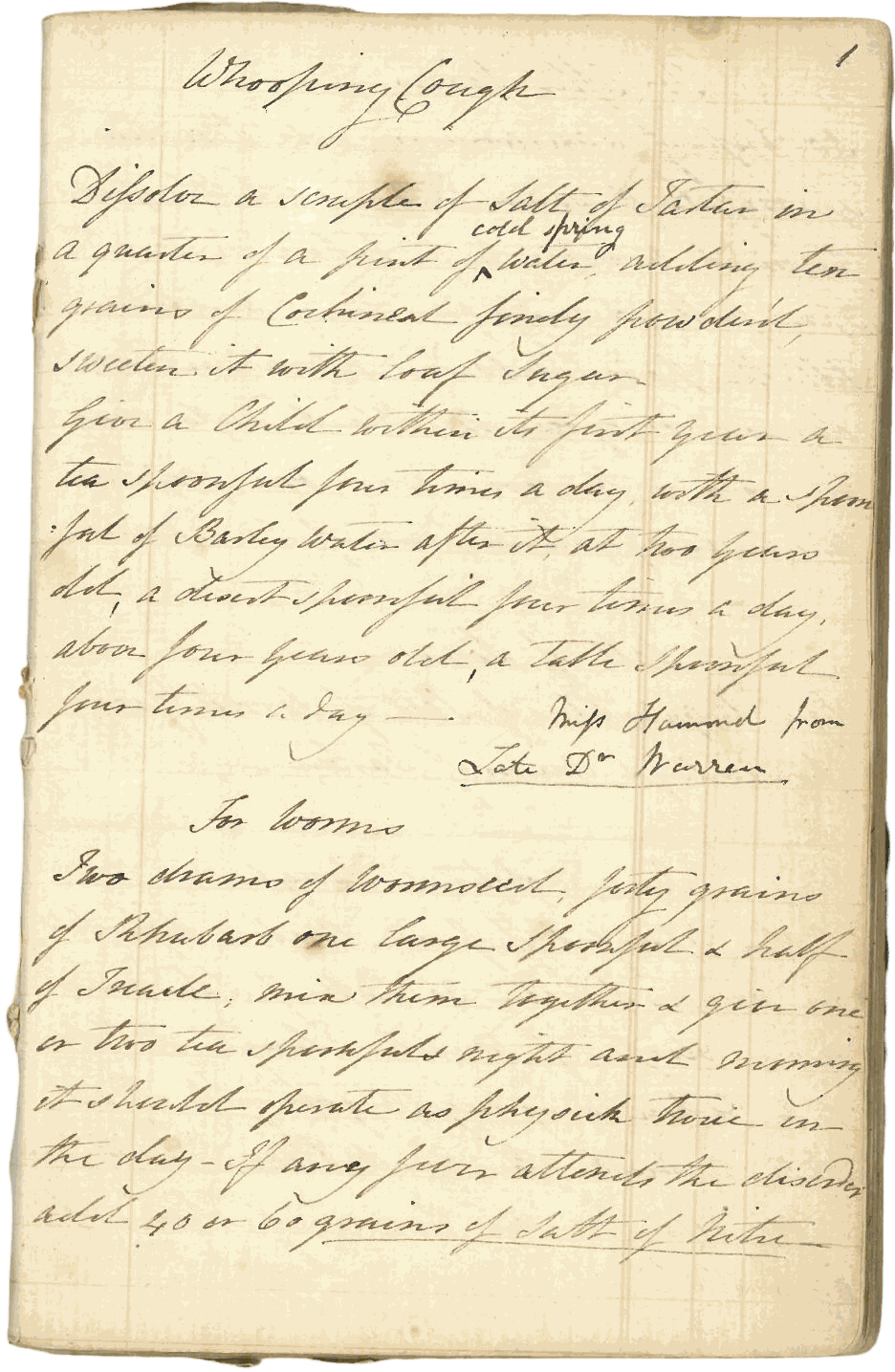
[Page 1]
Whooping Cough
Dissolve a scruple of Salt of Tartar in a quarter of a pint of [cold spring, inserted above] water, adding ten grains of Cochineal finely powder’d, sweeten it with loaf Sugar. Give a Child within its first year a tea spoonful four times a day, with a Spoonful of Barley Water after it; at two years old, a desert spoonful four times a day; above four years old, a table Spoonful four times a day — Miss Hammond from Late Dr Warren
For worms
Two drams of Wormseed, forty grains of Rhubarb one large Spoonful & half of Treacle; mix them together & give one or two tea spoonfuls night and morning it should operate as physick twice in the day — If any fever attends the disorder add 40 or 60 grains of Salt of Nitre
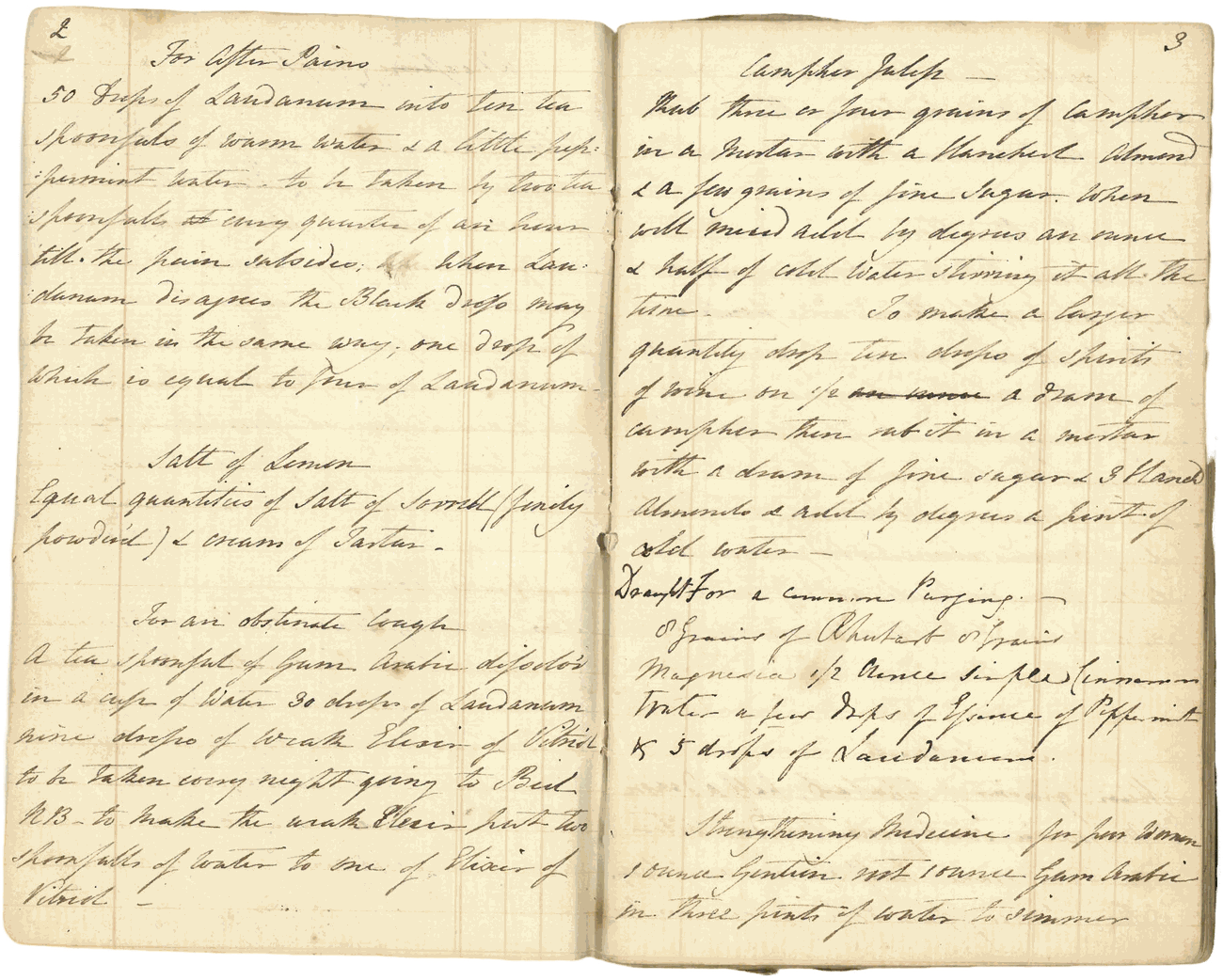
[Page 2]
For After Pains
50 Drops of Laudanum into ten tea spoonfuls of warm water & a little pep:permint water — to be taken by two tea spoonfuls at every quarter of an hour till the pain subsides. When Laudanum disagrees the Black drops may be taken in the same way, one drop of which is equal to four of Laudanum.
Salt of Lemon
Equal quantities of Salt of Sorrell (finely powder’d) & cream of Tartar.
For an obstinate Cough
A tea spoonful of Gum Arabic dissolved in a cup of Water 30 drops of Laudanum nine drops of weak Elixir of Vitriol, to be taken every night going to Bed. NB — to make the weak Elixir put two spoonfuls of water to one of Elixir of Vitriol —
[Page 3]
Camphor Julep —
Rub three or four grains of Camphor in a Mortar with a Blanched Almond & a few grains of fine Sugar. When well mixed add by degrees an ounce & half of cold Water stirring it all the time. To make a larger quantity drop ten drops of spirits of wine on ½ an ounce a dram of camphor then rub it in a mortar with a dram of fine sugar & 3 Blanched Almonds & add by degrees a pint of cold water —
Draught for a common Purging —
8 grains of Rhubarb 8 grains Magnesia ½ Ounce simple Cinnamon Water a few drops of Essence of Peppermint & 5 drops of Laudanum.
Strengthening Medicine for poor women
1 ounce Gentian root 1 ounce Gum Arabic in three pints of water to simmer [continued]
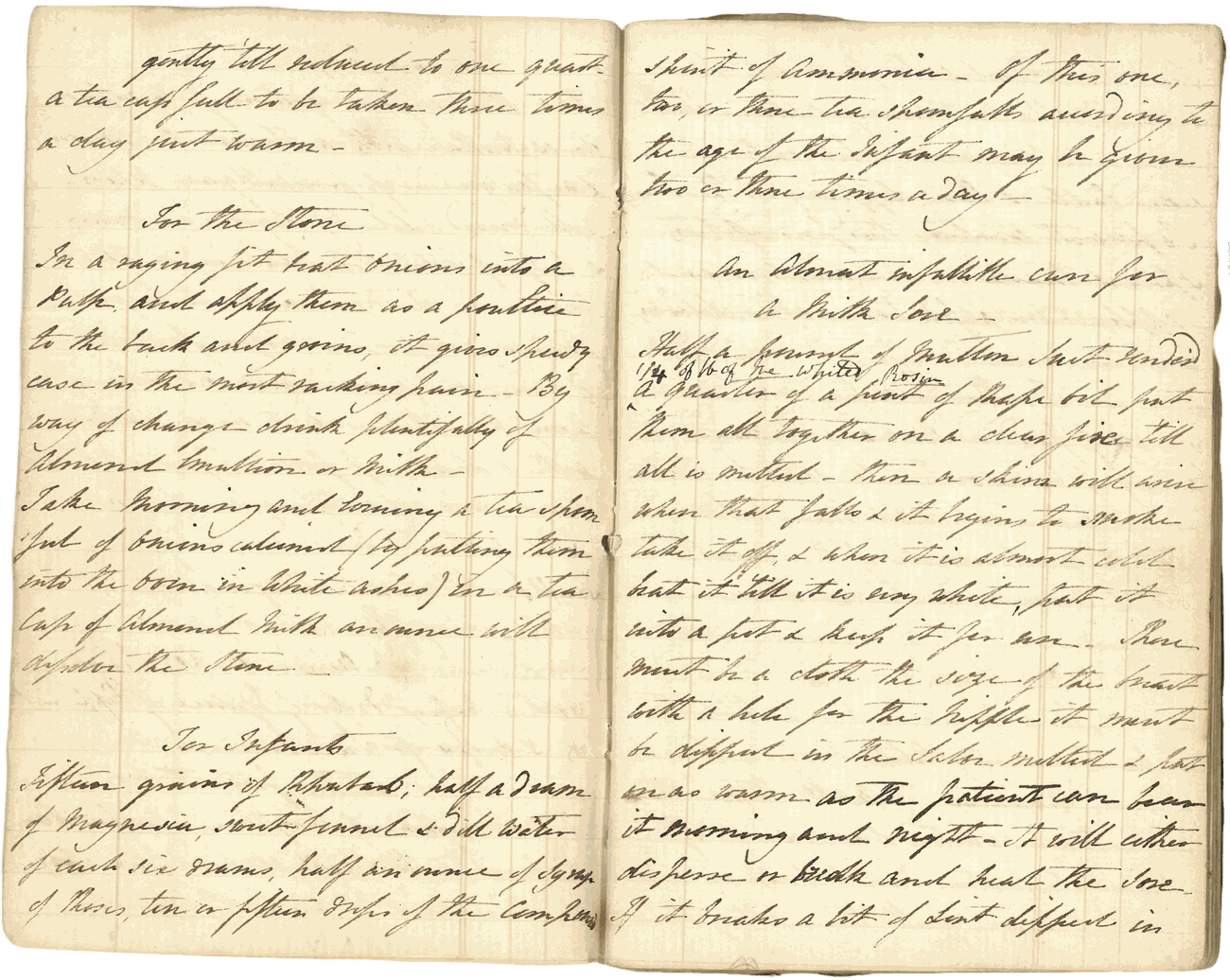
[Page 4]
gently till reduced to one quart — a tea cup full to be taken three times a day just warm —
For the Stone
In a raging fit beat Onions into a Pulp and apply them as a poultice to the back and groins, it gives speedy ease in the most racking pain — By way of change drink plentifully of Almond Emulsion or Milk —
Take Morning and Evening a tea spoonful of Onions calcined (by putting them into the oven in White ashes) in a tea cup of Almond Milk an ounce will dissolve the Stone —
For Infants
Fifteen grains of Rhubarb; half a dram of Magnesia, sweet fennel & dill water of each six drams, half an ounce of Syrup of Roses, ten or fifteen drops of the compound [continued]
[Page 5]
spirit of Ammonia — Of this one, two, or three tea spoonfuls according to the age of the Infant may be given two or three times a day
An almost infallible cure for a Milk Sore
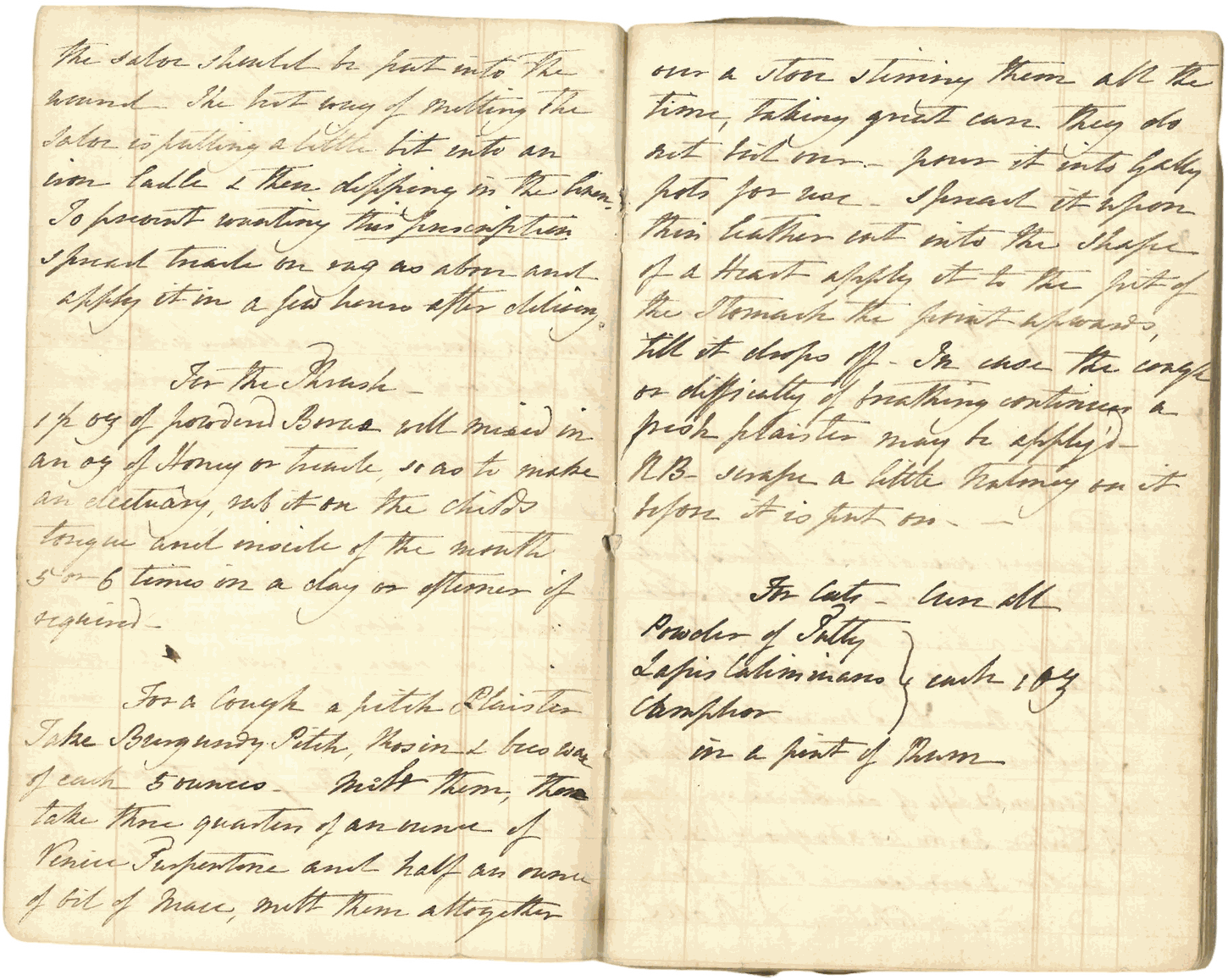
Half a pound of Mutton Suet rended [¼ lb of fine White Rosin, inserted above] a quarter of a pint of Rape oil put them all together on a clear fire till all is melted — then a skum will arise when that falls & it begins to smoke take it off, & when it is almost cold beat it till it is very white, put it into a pot & keep it for use. There must be a cloth the size of the breast with a hole for the Nipple it must be dipped in the Salve melted & put on as warm as the patient can bear it morning and night — It will either disperse or break and heal the Sore. If it breaks a bit of Lint dipped in [continued]
[Page 6]
the salve should be put into the wound. The best way of melting the Salve is putting a little bit into an iron ladle & then dipping in the linen. To prevent wasting this prescription spread treacle on rag as above and apply it in a few hours after delivery.
For the Thrush —
½ oz of powdered Borax well mixed in an oz of Honey or treacle, so as to make an electuary, rub it on the child’s tongue and inside of the mouth 5 or 6 times in a day or oftener if required —
For a Cough a pitch Plaister
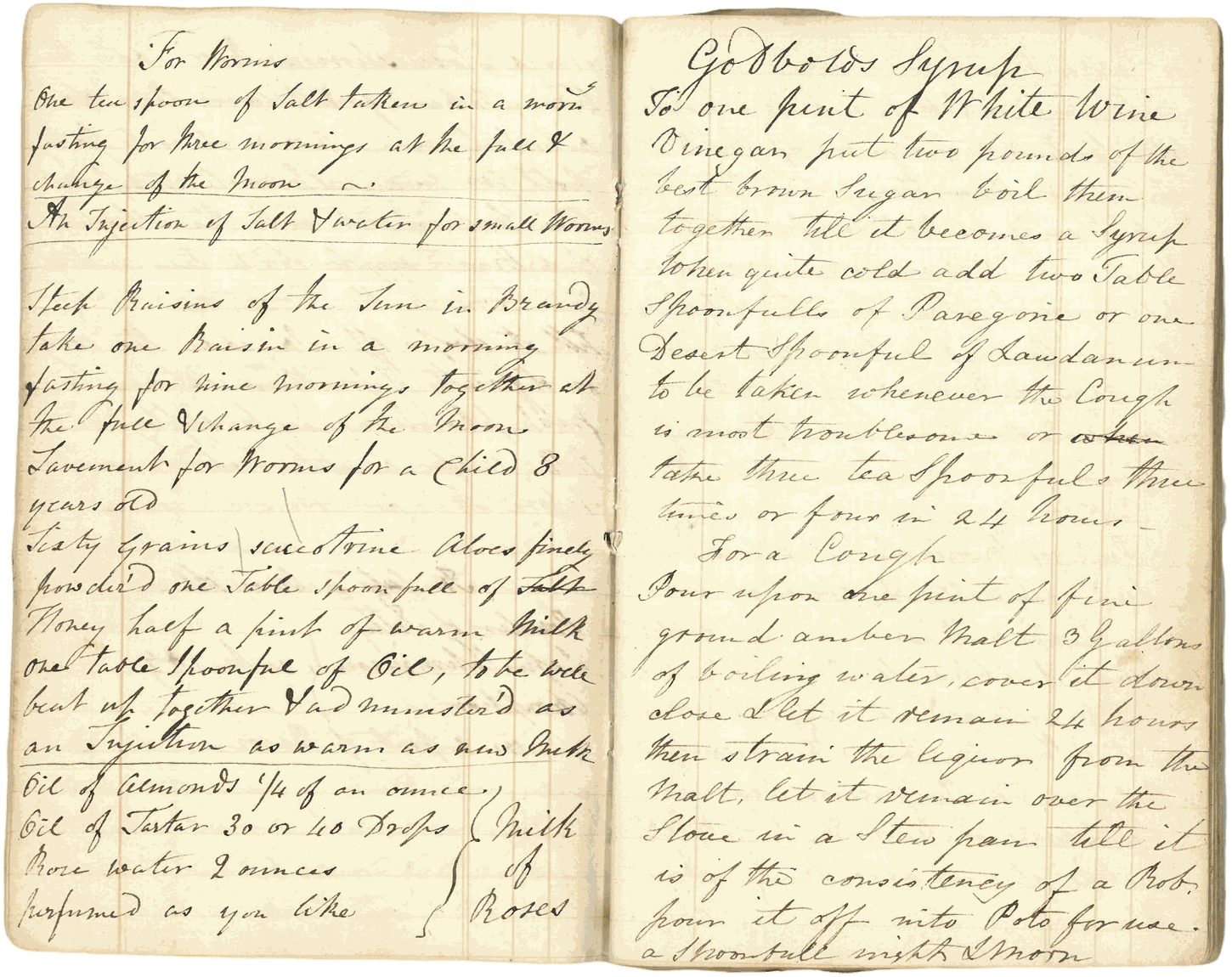
Take Burgundy Pitch, Rosin & bees wax of each 5 ounces. Melt them, then take three quarters of an ounce of Venice Turpentine and half an ounce of Oil of Mace, melt them altogether [continued]
[Page 7]
over a stove stirring them all the time, taking great care they do not boil over — pour it into Gally pots for use. Spread it upon thin leather cut into the shape of a Heart apply it to the pit of the Stomach the point upwards, till it drops off — In case the cough or difficulty of breathing continues a fresh plaister may be apply’d — NB — scrape a little Nutmeg on it before it is put on —
For Cuts — Cure all
Powder of Tutty
Lapis Calaminaris } each 1 oz
Camphor
in a pint of Rum
[Page 8]
For Worms
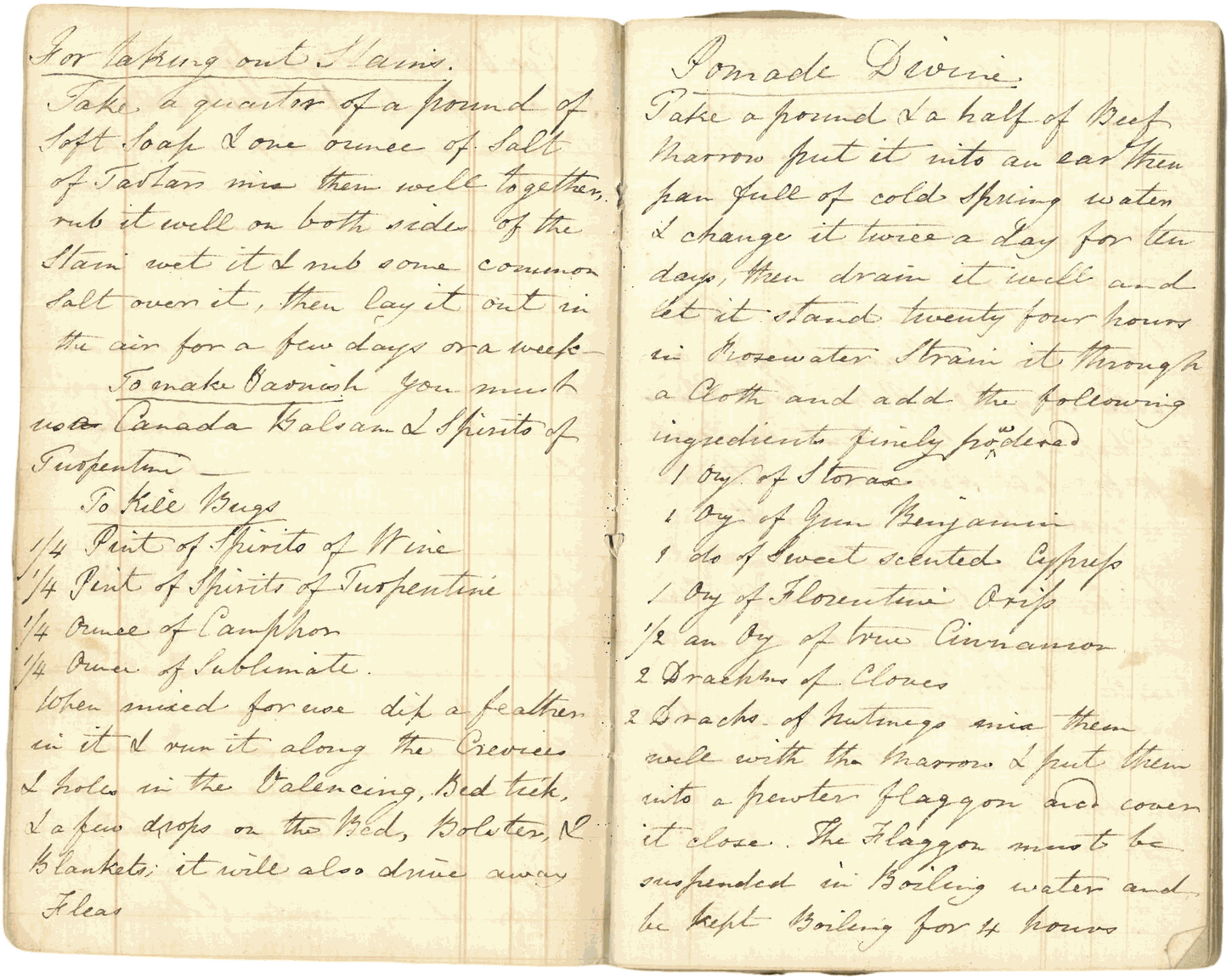
One tea spoon of Salt taken in a morng fasting for three mornings at the full & change of the Moon ~
An Injection of Salt & water for small Worms
Steep Raisins of the Sun in Brandy take one Raisin in a morning fasting for nine mornings together at the full & change of the Moon.
Lavement for Worms for a Child 8 years old
Sixty Grains succotrine Aloes finely powder’d one Table spoon full of Salt Honey half a pint of warm Milk one table Spoonful of Oil, to be well beat up together & administer’d as an Injection as warm as new Milk
Milk of Roses
Oil of Almonds ¼ of an ounce
Oil of Tartar 30 or 40 Drops
Rose water 2 ounces
perfumed as you like
[The title “Milk of Roses” is written to the right of these four lines, joined to them by a bracket]
[Page 9]
Godbold’s Syrup
To one pint of White Wine Vinegar put two pounds of the best brown Sugar boil them together till it becomes a Syrup when quite cold add two Table Spoonfulls of Paregoric or one Desert Spoonful of Laudanum to be taken whenever the Cough is most troublesome or when take three tea Spoonfuls three times or four in 24 hours —
For a Cough
Pour upon one pint of fine ground amber Malt 3 Gallons of boiling water, cover it down close & let it remain 24 hours then strain the liquor from the Malt, let it remain over the Stove in a Stew pan till it is of the consistency of a Rob. pour it off into Pots for use. a Spoonfull night & morn
[Page 10]
For taking out Stains.
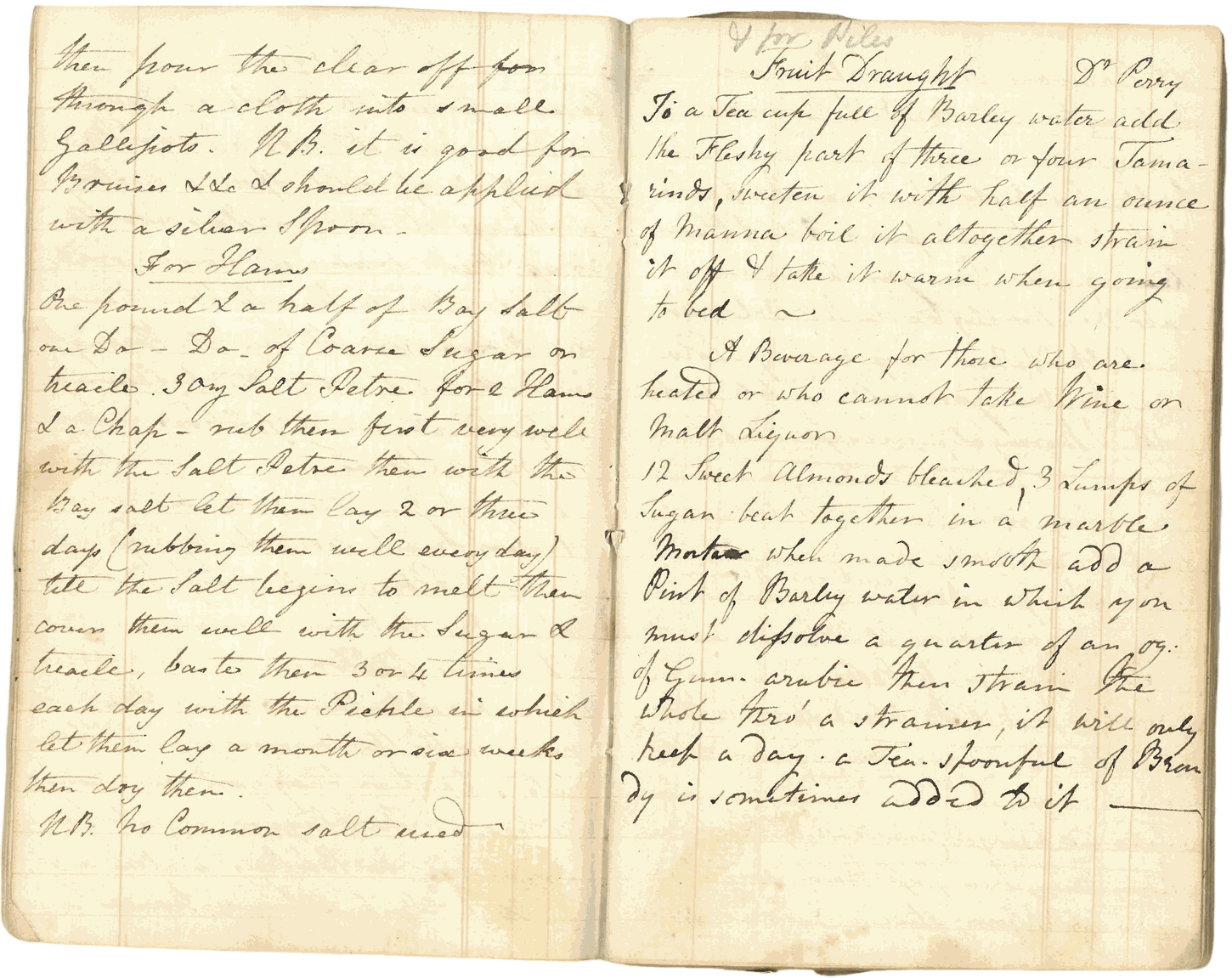
Take a quarter of a pound of Soft Soap & one ounce of Salt of Tartar mix them well together, rub it well on both sides of the Stain wet it & rub some common salt over it, then lay it out in the air for a few days or a week —
To make Varnish you must use Canada Balsam & Spirits of Turpentine —
To Kill Bugs
¼ Pint of Spirits of Wine
¼ Pint of Spirits of Turpentine
¼ Ounce of Camphor
¼ Ounce of Sublimate.
When mixed for use dip a feather in it & run it along the Crevices & holes in the Valencing, Bed tick, & a few drops on the Bed, Bolster, & Blankets; it will also drive away Fleas
[Page 11]
Pomade Devine.
Take a pound & a half of Beef Marrow put it into an earthen pan full of cold Spring water & change it twice a day for ten days, then drain it well and let it stand twenty four hours in Rosewater. Strain it through a Cloth and add the following ingredients finely powdered
1 Oz of Storax
1 Oz of Gum Benjamin
1 do of Sweet scented Cypress
1 Oz of Florentine Orris
½ an Oz of true Cinnamon
2 Drachms of Cloves
2 Drachms of Nutmegs mix them well with the Marrow & put them into a pewter Flaggon and cover it close. The Flaggon must be suspended in Boiling water and be kept Boiling for 4 hours
[continued]
[Page 12]
then pour the clear off through a cloth into small Gallipots. N.B. it is good for Bruises &c & should be applied with a silver Spoon.
For Hams
One pound & a half of Bay Salt one Do — Do — of Coarse Sugar or treacle. 3 oz Salt Petre for 2 Hams & a Chap — rub them first very well with the Salt Petre then with the Bay salt let them lay 2 or three days (rubbing them well every day) till the Salt begins to melt then cover them well with the Sugar & treacle, baste them 3 or 4 times each day with the Pickle in which let them lay a month or six weeks then dry them.
N.B. No Common salt used
[Page 13]
[“& for Piles” added above the heading]
Fruit Draught Dr Perry
To a Tea cup full of Barley water add the Fleshy part of three or four Tamarinds, sweeten it with half an ounce of Manna boil it altogether strain it off & take it warm when going to bed ~
A Beverage for those who are heated or who cannot take Wine or Malt Liquor
12 Sweet Almonds blanched, 3 Lumps of Sugar beat together in a marble Mortar when made smooth add a Pint of Barley water in which you must dissolve a quarter of an oz. of Gum arabic then strain the whole thro’ a strainer, it will only keep a day. a Tea-spoonful of Brandy is sometimes added to it
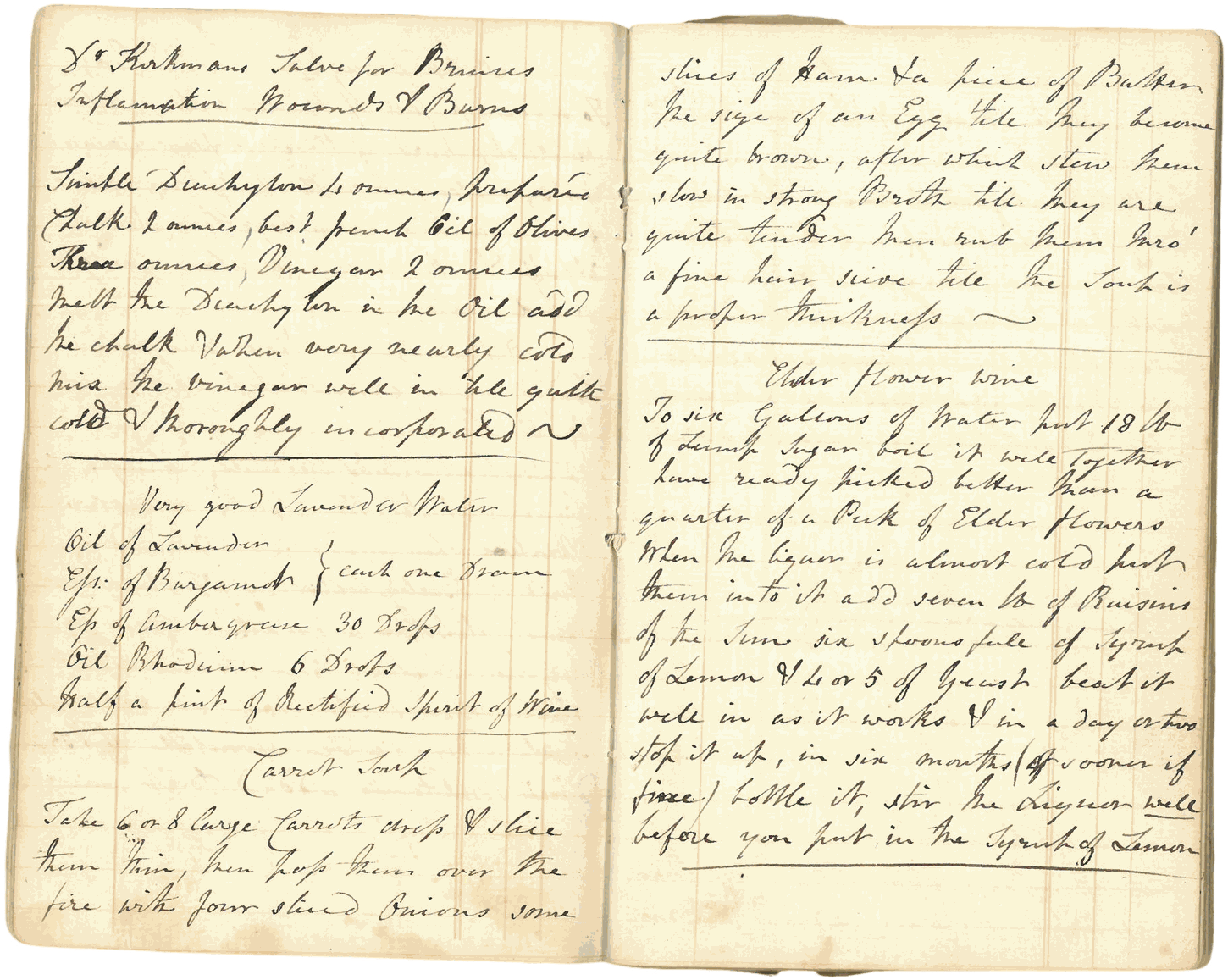
[Page 14]
Dr Kirkman’s Salve for Bruises Inflammation Wounds & Burns
Simple Diachylon 4 ounces, prepared Chalk 2 ounces, best french Oil of Olives Three ounces, Vinegar 2 ounces Melt the Diachylon in the Oil add the chalk & when very nearly cold mix the Vinegar well in till quite cold & thoroughly incorporated ~
Very good Lavender Water
Oil of Lavender
Ess. of Bergamot } each one Dram
Ess. of Ambergrease 30 Drops
Oil Rhodium 6 Drops
Half a pint of Rectified Spirit of Wine
Carrot Soup
Take 6 or 8 large Carrots chop [?] & slice them thin, then pass them over the fire with four sliced Onions some [continued]
[Page 15]
slices of Ham & a piece of Butter the size of an Egg till they become quite brown, after which stew them slow in strong Broth till they are quite tender then rub them thro’ a fine hair sieve till the Soup is a proper thickness ~
Elder flower wine
To six Gallons of Water put 18 lb of Lump Sugar boil it well together have ready picked better than a quarter of a Peck of Elder flowers when the liquor is almost cold put them into it add seven lb of Raisins of the Sun six spoons full of Syrup of Lemon & 4 or 5 of Yeast beat it well in as it works & in a day or two stop it up, in six months (or sooner if fine) bottle it, stir the Liquor well before you put in the Syrup of Lemon
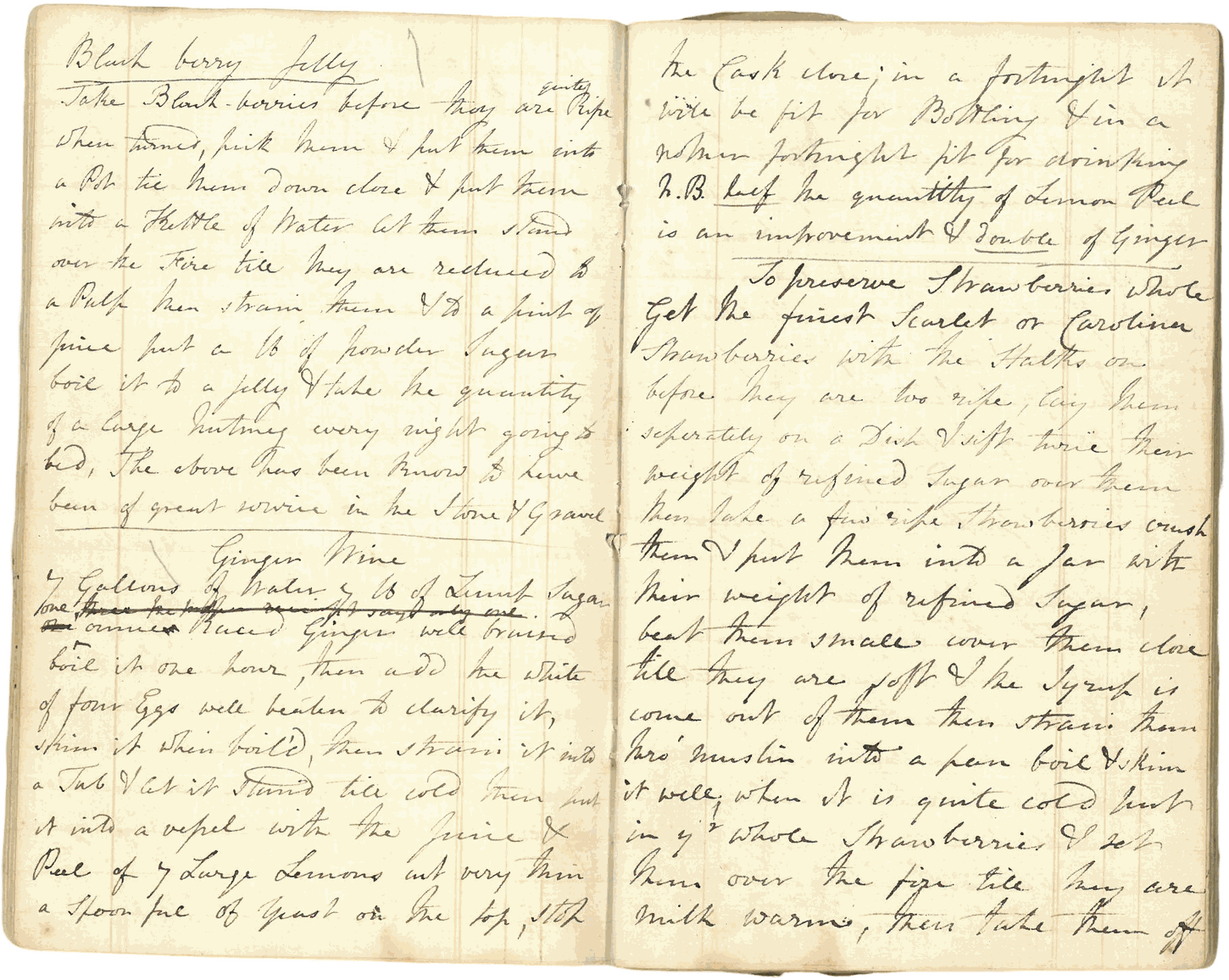
[Page 16]
Black berry Jelly
Take Black-berries before they are [quite, inserted above] Ripe when turned, pick them & put them into a Pot tie them down close & put them into a Kettle of Water let them stand over the Fire till they are reduced to a Pulp then strain them & to a pint of juice put a lb of powder Sugar boil it to a jelly & take the quantity of a large Nutmeg every night going to bed, The above has been known to have been of great service in the Stone & Gravel
Ginger Wine
7 Gallons of Water 7 lb of Lump Sugar one [several words struck through, illegible] ounce Raced Ginger well bruised boil it one hour, then add the white of four Eggs well beaten to clarify it, skim it when boil’d, then strain it into a Tub & let it stand till cold then put it into a vessel with the Juice & Peel of 7 Large Lemons cut very thin a Spoonful of Yeast on the top, stop [continued]
[Page 17]
the Cask close; in a fortnight it will be fit for Bottling & in a nother fortnight fit for drinking
N.B. half the quantity of Lemon Peel is an improvement & double of Ginger
To preserve Strawberries Whole
Get the finest Scarlet or Carolina Strawberries with the Stalks on before they are too ripe, lay them separately on a Dish & sift twice their weight of refined Sugar over them then take a few ripe Strawberries crush them & put them into a Jar with their weight of refined Sugar, beat them small cover them close till they are soft & the Syrup is come out of them then strain them thro’ muslin into a pan boil & skim it well, when it is quite cold put in yr whole Strawberries & set them over the fire till they are milk warm, then take them off [continued]
More to come... Do please return